Day 1: September 7
BORAT FILM SABOTAGED!
Kazakhstani television star/hand model blames
"Jews".
|
|

Borat Rallies the
Crowd |
|
Ryerson Theatre, Toronto
Shocking audience
members and 20th century fox executives alike, a kabal of "Jews, women and
Gypsies" hijacked tonight's premiere of Borat: Cultural Learning of
America for Make Benefit Glorious Nation of Khazakhstan for nefarious
reasons not yet made public.
While hefty left-wing fiction filmmaker
Michael Moore entertained the crowd, Borat's enemies got the better of his film
by successfully postponing it until tomorrow evening, or the second coming of
the messiah, whichever comes first.

Yeah... complete meltdown. We all felt for Colin et. al.,
and the crowd was on a total high when the projector choked and died. During
the hour or so they tweaked to try and fix it, we did get some entertainment,
including an incredibly lame "mentalist" act who seems to travel with his toys.
Nothing like prop comedy in a crowded theatre I say...
Dignitaries such
as successful reality TV host Ben Mulroney and (un)successful reality TV host
George Stroumboulopoulos were on hand for the showing, along with a number of
other prominent stars, a slew of media outlets, etc. It's a real shame that the
screening went down so poorly, but the entrance alone made for one of the
highlights of any MM year.
The previous hours were spent trying to stay
awake, despite the fact that this is but day one. Seems I'm getting old and
jaded as the fests tick by, day one and I'm already a wreck...

|
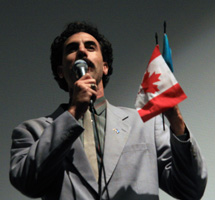
|
|
|

Michael Moore & Larry
Charles |
|
|

Ali-G Superfan |
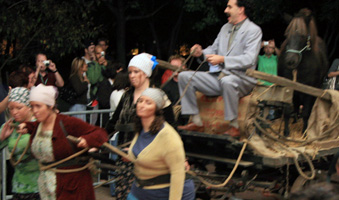
The Women Before the
Horse |
|
|
|
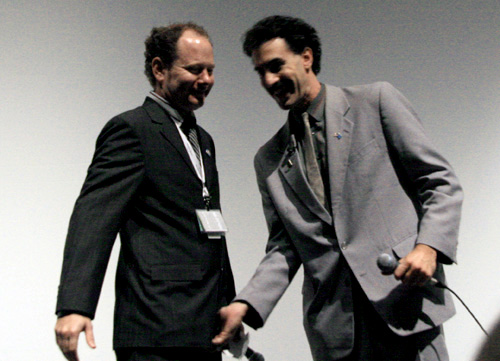
WA WA WEE WAHHH! |
|
|
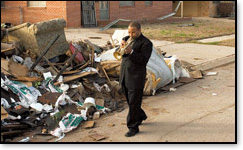 |
When The Levees Broke: A Requiem In
Four Acts
Directed by: Spike Lee
Grade:
B+
Spike Lee (with the help, according to the credits, of a number
of NYU Film school interns) has crafted a lengthy, quite compelling look at
Hurricane Katrina and its aftermath. Mixing news footage with talking-head
interviews with survivors and those in power, this "Film Document" does an
admirable job of detailing many of the key elements that made the disaster of
Katrina far more powerful than simply the storm that hit.
The structure
follows four acts, acts that do tend to blend into one another rather than
creating cut and dry chapters differing from one another. The length of the
film allows for contradictory accounts and recollections to butt against one
another, with certain urban myths/theories such as the potential deliberate
bombing of the levees given due course. Even Kayne West's "George Bush doesn't
like Black people" remark is given ample reflection. The length also,
unfortunately, adds a sense of repetition that reduces in part the
effectiveness of certain sequences.
With the events only a year old,
there is both a freshness and lack of resolution to the entire proceedings,
with many interviews taking place when the anger is still at a boiling point.
This is both a strength and weakness of the film, as it lacks an inevitable
perspective that will come as time goes on, while at the same time conveying
poignantly the anger and frustration felt by all of those
participating.
Certain scenes seem to be overly obtrusive and blunt,
certain points are literally battered over the viewers heads (the repetition of
certain lines, for example, becomes a little too stylistically "cute" for my
liking), but the general sense is of a well rounded anthology of a particular
time in American history. For those that were glued to the 24 hour news
stations (myself included) much of the first half will be familiar, with
familiar footage played over and over throughout the hours. The second half,
that concentrates more fitfully on those introduced in the first along with a
look at the greater history of New Orleans, is thus all the more satisfying.
For those that haven't seen the footage from the convention center, or of the
bodies floating and dramatic helicopter rescues, the film will surely be a
revelation.
Regardless of this TV film's merit as a festival film
(noting that HBO documentaries are better than most films screened at the
fest), When the Levees Broke provides an extraordinarily detailed look
at this event, and its worth is sure to be felt increasingly as the memories
fade and the anger softens with time and distance.
|
|
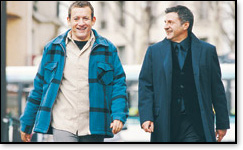 |
Mon Meilleur Ami (My Best
Friend)
Directed by: Patrice Leconte
Grade:
B
This is perhaps what passes for puff-piece, light-comedic adult
films in France, which is saying something quite positive about contemporary
French pop cinema. A man (Daniel Auteuil) finds out that he actually has no
friends (only acquaintances and colleagues) and sets out to find a friend in
order to settle a bet with his co-worker (the radiant Julie Gayet).
The
plot ends up having enough holes to drive a taxi through, but for some reason
it all works so well. It's a difficult thing, reflecting upon friendship
between two men as they express their feelings without it seeming maudlin. Most
buddy movies, for example, don't concern themselves with the nature of buddies,
they just take friendship for granted. This film does the opposite, creating a
buddy film where the entire pursuit is for that closeness of friendship two men
can share, a closeness that's at once secure and tacit.
The direction is
deft, performances fine, and the finale a fun time, but it all seems to be an
admixture of heavy reflection upon trust and a light, silly troll through a
mid-life friendship crisis. It certainly does not take a genius to see where
the script is going some ten minutes into the flick, but, again, that didn't
seem to detract from the film. In the end, it was an enjoyable, light film to
kick off the morning. Discussions about an English language remake (it bears
the same tone as another French-to-Hollywood transplant, Three Men and a
Baby) may be happening as I type...
|
|
 |
The Wind that Shakes the
Barley
Directed by: Ken Loach
Grade: A
Lots
of my favourite war films (Full Metal Jacket, Saving Private Ryan, etc.)
start with a tremendous flourish, lots of ambivalence and confusion that
eventually settles down into a somewhat traditional playing out of war film
thematics. Loach's film about Northern Ireland plays in exactly the opposite
way. The first hour is so stark, so black-and-white that the Brit "bad guys"
are so wooden and predictably evil they could be Nazis in a 50s serial.
Englishment blindly brutalize the protagonists without provocation, smashing
bones with giddy abandon. Just when this onslaught of us-versus-them is at its
highest point, chinks begin to form. Reference is made to the hell some of
these soldiers survived in the Great War, and disagreements begin to arise
amongst the Irish. Black and White begins it process towards grey.
The
tone of the film becomes even more challenging (and beguiling) as a treaty is
signed with the British overlords. The transition from guerilla to soldier is a
fractious one, and it is here that the moral ambiguity of the film truly gains
its complexity.
The last half of the film presents in a shockingly
honest way the complexity of this transition. The performances are shattering,
made all the more harrowing by the situations the characters find themselves
in. Without ruining the ending, the film is absolutely unflinching, and what
starts as a simple, adolescent tale of brotherhood and rebellion turns into a
very adult, very real examination of the political and moral decisions driving
nationalist organizations. Exceptional, intelligent, accessible, and poetic (in
a good way!) it's a film from the master Loach that's not to be missed.
|
|
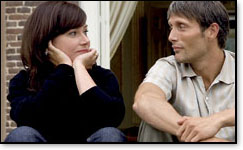 |
After the Wedding
Directed
by: Sussanne Bier
Grade: B-
Another Danish family
drama, this one involving a Billionaire, his wife and family, and an idealistic
teacher of orphans living in the slums of Bombay. Plot-wise, this is a
predictable mish mash of tragic situations, deceit, powerplays and
reconciliation. The film's actors, however, bring such raw, powerful
performances that the story limitations are for the most part forgotten about.
Some of the scenes are downright devastating, as the various characters
come to terms with their own choices. It's not nearly as spectacular of other
contemporary Danish films, but the craft and acting bring it above the genre in
which it slips.
|
|
 |
King and the Clown
Directed
by: Lee Jun-ik
Grade: C-
Admittedly, this was my first
Korean clown-and-king epic with a dash of gay subtext, but King and
Clown is, to my mind at least, a baffling mess of a film. There are moments
of great beauty and fun, with acrobat scenes shot with aplomb, beautiful
colours and costumes floating across the screen. At other times, it's an arch,
melodramatic mess not even worthy of daytime soaps. The trick, I guess, is for
that not to get you down.
The story is apparently derived from the true
tale of a mad, brutal king, circa 1500 AD, who invited a bunch of jesters into
his court despite the fact that they were known to break the rules and taunt
the ruler himself. The first hour of the film, building up the jesters to enter
the court, picking up ragtag side characters as the march to Seoul takes place
was quite enjoyable, and the acrobatics were quite impressive.
Underlying this main plot is the fact that the two (male) protagonists
do a girl/guy schtick, and the "girl" in the act is quite striking an fair,
often bartered out to help pay the bills. The fairness of the character is so
fine that even the King falls for him, scandalizing the court even more than
the jesting of the King, ministers, and other officials and members of the
court.
That much was straightforward - where the film totally goes out
to left field is where a non-sexual, non-physical love triangle (and various
other forms of betrayal) cumulating with the slitting of wrists (and surreal
resurrection), some operatic fight scenes, a bunch of tame sexual exploits and
other related hanky panky. The programme guide extolls the fact that this was
the biggest hit in Korean history, and I can't help but feel that this fact a)
shows there may be more depth in the flick than I'm giving it credit for, or,
more likely, b) this is the same type that flocked to Titanic for the sense of
soft seduction in a period setting.
The book also ties the homoerotic
elements to last year's big success, citing the label of "Korea's Brokeback
Mountain" given to the film. Frankly, this is just insulting to the fine
Brokeback (is there a new rule that all future films that take place
outdoors and have a hint of homoeroticism be compared to that flick?). As the
film collapses to its messy, ridiculous conclusion I was left with a strong
feeling of a lost opportunity, a potentially enlightening epic coated with
enough schmaltz to make it almost camp.
|
|
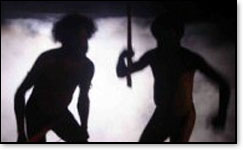 |
Ten Canoes
Directed by: Rolf
DeHeer
Grade: A-
Ten Canoes is a deep, flowing
tale, elegiac in its pacing, beautifully shot. The narrator begins with "A long
time ago, in a place far, far away...", then cracks into laughter, saying it's
not "your story, but my story...", a different, but just as good tale handed
down from his ancestors.
The story flows with deliberate patience,
different branches of the story "like the trees" finding their own pace.
There's no moral per se, but there is a sense of deep wisdom as the story
unfolds.
The narration was in English, but the dialogue was entirely in
the native language(s) of the Aboriginal actors. There is a strong
verisimilitude in the production, documentary in its rawness, the naked bodies
of the actors taken for granted as being as natural as the landscapes. After a
while, certain words and phrases of the aboriginal language could be discerned,
and the story flowed richly without the need for subtitles. Surprisingly, the
lack of subtitles that I found to be a challenging and exciting part of the
experience was infact an accident of print shipments. Regardless of this
accident of print management, the film remained entirely comprehensible,
forcing the viewer to pay careful attention to extratextual gestures and
physical cues, helped in turn by the laconic, omniscient narration that runs
throughout.
A remarkable film, made all the more enjoyable by this happy
subtitling accident at the screening.








