 |

TORONTO INTERNATIONAL FILM FESTIVAL
Diary 5: Sept. 11,
2000
|
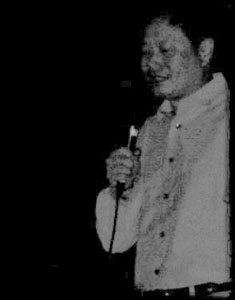
ANG LEE - UPTOWN SCREENING |
|
I
am, I think, a pretty hard marker. I try to mark fairly, but I try not to give
overly inflated marks to undeserving items.
It's thus all the more
surprising to me that a huge chunk of the films I'm seeing this year are in the
"A" range. It's a mix of luck and skill - as I get better at negotiating the
festival, I learn what screenings I wish to go to. Psychoanalysing the writeups
in the catalogue could be a full time job - deciphering catch phrases such as
"deliberately paced" to mean "really bloody long", for example. Not rocket
science, but certainly something that develops over the years.
It
shouldn't be surprising, however, that a lot of the marks are high - in theory,
all are supposed to be A+ films, the cream of the international crop,
the largest public festival in the world. Why, then, are there total duds in
the first place?
In a summer where the films have basically sucked
pretty badly, I may be being more generous than I should. But, in the end, I'll
stand by my marks. After all, what is film criticism if its not a starting
point for an argument?
Got a chance to see and hear Ang Lee tonight
talk about Crouching Tiger, Hidden Dragon- the film was budgeted at $15
million and made for $10 - which, in short, is bloody astounding. The thing
could easily be thought to be a $150 million epic. He spoke of the logistical
hell of driving crane trucks into bamboo farms, and filming in a remote area of
the Gobi desert near the border with Khazakhstan, where it is unlikely that
anyone has ever made a film before. The crowd was really into the early morning
screening, cheering with every new flourishing action sequence.
Bagged
off early with only four films under my belt to do some work, with a big day
tomorrow.

CROUCHING TIGERS, HIDDEN DRAGON
Directed by: Ang
Lee
It would not be an understatement to say that Ang Lee is perhaps
the most artistically successful and diverse Asian-American filmmaker. From
period pieces to suburban drama/thrillers, Lee tackles a variety of genres
while managing to maintain his strong artistic mark on the individual
work.
With his latest film, Lee has created a lyrical fairy tale for
adults, a sublime synthesis of martial arts action with dramatic
sophistication.
Chow Yun-Fat and Michelle Yeoh lead a cast that for
once in an Asian action film have passionate and interesting words to come out
of their mouths (are Kurosawa film's "action" films?). The story is a fairly
simple, if not downright archetypical in a Campbellian sort of way. Lee is
adept in overcoming what he expressed was a real fear, that the dialogue
sections would simply stand as a delay between action sequences.
The
most impressive part of the film, in the end, are the luscious visuals and
joyful martial artistry exhibited by the cast, coupled with a beautiful,
metaphysical tale. Yuen Wo-Ping, know internationally for his work on The
Matrix, lends his wire-rigging expertise to this films. Where the
Matrix fight scenes were video game-like in their construction, the
detailed, choreographed conflicts in this film are like powerful dance
movements. The weapons choreography alone is astounding, but it is the
suspension of the actors, in conjunction with suspension of disbelief, that
gives the film its unique character. The conflicts are lighting fast but
performed with a great lightness, as the actors actually float up walls and
onto roofs. The camera tracks wildly, but never creates a claustrophobic sense.
The film plays like a Zhang Yimou-meets-John Woo dream pairing. From
stark desert locations to an unforgettable battle in the trees, Lee has created
an instant genre defying classic. He did it without pandering to the audience,
or putting in unwarranted comic relief characters.
Crouching Tigers,
Hidden Dragon is simply a beautiful and powerful extension of the action
and drama genres - a real achievement.
Grade: A+
Der Krieger und die Kaisering (The Princess and the
Warrior)
Directed by: Tom Tykwer
How do you follow up
with one of the most kinetic films ever made? The obvious answer would be to
slow things down, take a more introspective and less visceral approach. In
short, do something different.
This is precisely what Run Lola
Run's director Tykwer has accomplished with his latest film. Trading techno
for ambient styles, the film is a technically impressive take on a
unconventional love story. Swooping crane shots mix with powerful performances,
and both the filmmaking and performace sides of the movie prove to be
dexterous.
Franka Potente ("Lola" in her husband's last film) plays a
nurse at an institution for the mentally disturbed. She fulfils her patient's
needs, with some fulfilments more ethcial than others. Bodo, meanwhile, can't
stop crying and can't hold a job. The meeting of these two is one of the few
RLR-ish momemts, and the pacing of this scene in particular is
impressive.
Long sequences (expemplified by the final seemingly-infinite
pullback) try to allow for introspection, but occassionaly just seem to drag.
This, coupled by several false denouements, will be problematic for some. The
story, while not outright surreal, nonetheless throws some interesting curves.
In a festival atmosphere, after a large number of films, it is quite tiring at
times. Screened along with the patience to absorb the film as it unfolds, will
no doubt be even more rewarding.
Grade: B+
In the Mood For Love
Directed by: Wong
Kar-Wai
Wong Kar-Wai's films are often stunning examples of how
different and beautiful the Hong Kong aesthetic can be. A termendously
confident filmmaker, Kar-Wai needs not rely upon cliché, moody sex
scense or gratuitous action sequences to provide points of
interest.
With his lens, Kar-Wai can focus on the randomness of
rainfall, the back of a woman's neck, even a toaster, and the impact can be as
great as any lesser director's monstrous and bombastic finale.
The first
thing that must be said is that it is a sublimely beautiful film. Rich, lush
colours of dark crimson drape over 60s kitsch formica. Bright yellow hues melt
to gold, replicating the visual style of his urban films like Chunking
Express but without ever seeming forced. I think that this is key to
Kar-Wai's success -- he never composes a shot that seems wasted or accidental.
Yet, even shots that are the most abstract (such as when he shoots people from
the waist down, or the utilization of dusty distorted mirrors to transform the
images) support what is essentially a simple narrative.
The
performances are quietly aching, never relying on explosions to push a point
home. The film's music is purposefully repetitive, with a prevailing theme
being Nat King Cole's Spanish-language rendition of "Perhaps, Perhaps,
Perhaps". If there's a central theme to this film, its that the question of
invitation or opportunity ("Perhaps?") can just as readily be declined as
accepted ("Perhaps not.") This ambivalence between opportunity and regret fuels
the film.
Kar-Wai's sublime imagery simply adds depth and resonance to
what is, laid bare, a tragic story of love's labour being lost due to misguided
senses of duty and responsibility. A beautiful film.
Grade:
A
Holdup
Directed by: Florian
Flicker
Holdup is a simple tale of a man who goes to rob a store to
pay alimony. He chickens out, and stumbles into a tailor's store across the
street. The lead, still in his clown-masked holdup uniform, decides to hold the
owner and his fragile customer hostage to get his cash.
The film
consists basically of the three of them locked into a room for the rest of the
film. I found most of the action predictable, and had little concern for the
characters.
The story obviously exploits the limitations of the theatre
- the whole thing occupies one major set piece (the store) and is far more
verbal than visual. This claustrophobic setting sometimes works (Reservoir
Dogs, Clerks), but in this case you don't really like any of the
guys, thus don't really care when they (inevitably) start getting on each
other's nerves.
The film is very heavy handed and obvious, but not
unwatchable. A mediocre movie, the story lacks the kind of payoff that would
have made the ordeal more bearable.
Grade:
C-
|
 |
|






