 |

TORONTO INTERNATIONAL FILM FESTIVAL
Diary 1: Sept. 7,
2000
 |
My
lord, it's fest time again
I couldn't help but spend some time today
thinking that, if I could swing it, I'd spend all my days like I did today. I
woke up at about 10am, got on a subway, and watched a movie. Then I watched
another... and another... and another.... well, you get the idea.
In
between, I got to catch up with some people, had a good noodle lunch, enjoyed
the sunny day between screenings, walked around downtown Toronto, and generally
had a great day.
This year, unlike previous years, is one of complete
freedom - I have nobody to account to, save you, the reader. Fil and Carm, the
bosses at CGX, do have some say, but this baby's mine for the fest. After
having to succumb to the schizo reactions of New York editors, with their
general lack of support, is a great feeling to know that I'm able to do what I
wish to do.
So, over this week, I plan on seeing around 60 films -
that's the goal, at any rate. Some reviews will be smaller, some longer. All
spelling and grammar mistakes are my own - the sad result of quick reporting on
little sleep. Some reviews will be revisited after some reflection, others will
be added to after subsequent screenings. At the least, please allow this daily
account and reviews to give you my sense of this 25th Toronto International
Film Festival.

Die Stille nach dem Schuss (The Legends of
Rita)
Directed by: Volker Schlöndorff
Starring: Bibiana
Beglau, Martin Wuttke, Nadja Uhl, Harald Schrott
The Legends of
Rita tells the tale of a group of leftist terrorists causing financial
havoc in 1970s West Berlin. They are a jovial if militant bunch, robbing from
banks while treating the bank patrons to packaged cupcakes, even politely
inviting an elderly woman in from outside as she enters the bank.
The
film's frenetic opening sequence, complete with fast cuts and interesting
camera angles, is sadly a pale memory by the time the film finally comes to its
melodramatic end. The film slips into trying to be an introspective, patient
examination of the underlying ideological commitments that were supposed to
make socialism a workable system. The narrative tells this tale by focusing on
Rita, one member of the foursome. Pegged as a terrorist, she must find refuge
in East Germany, isolated from her comrades-in-crime for the sake of a new
identity.
As the story creeps towards 1989, Rita's story becomes less
and less interesting, taking on a preaching tone. After awkward homo- and
heterosexual love affairs, in the end we are left with only Rita alone. Her
"legend" is pluralized in the English title, perhaps to indicate the radical
changes that Rita must undergo - change of name, of country, of lover. Yet in
the end, it is not Rita that changes, but the world she lives in. These
changes, while allegorically tied to her legends, prove far more interesting
than her own metamorphoses.
The film could have been an insightful
examination of the East/West divide that kept Germany apart for almost half a
century. Instead, the film's early potential slows to a halt, and the
predictable machine of melodrama takes over the drive of the
narrative.
Grade: C
STARDOM
Directed by: Denys Arcand
Starring:
Jessica Paré, Dan Aykroyd, Robert lepage, Frank
Langella
JESSICA PARÉ - STARDOM |
As if to revitalise my faith in cinema itself (woah, has this
summer sucked for movies!), Arcand's Stardom is a shining example of
great filmmaking. Good movies aren't dead, they just moved to Canada.
Stardom is to Altman's Pret-a-Porter (Ready to Wear)and Allen's
Celebrity what Don McKeller's T.O. fest hit Last Night was to
Deep Impact and Armageddon - an embarrassingly more accomplished
film that shames its American competition. While Last Night/Deep
Impact/Armageddon dealt with explicit impeding Apocalypses (is there a
plural?), Stardom deals with but one of the harbringers of said
end-of-the-world-as-we-know-it – namely, the rise of the Supermodel
class.
Arcand, director of, among other films, the stupendous Jesus
de Montreal, has created a very cinematic film that nonetheless exploits
the "teleliteracy" of modern film goers and TV watchers. The film traces the
rise and fall of a flavour-of-the-moment Supermodel from Cornwall, Ontario, as
she climbs the high peaks of international stardom, all while trying to get a
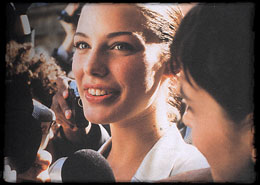
word in edgewise. We follow the hockey-playing Tina (played perfectly by
first-time actor Jessica Paré) to Paris, London and New York, as she
collects men and acclaim like so much jewellery.
From about 30 seconds
into the film, the camera becomes a first person documentation of the events.
Never forced or contrived, the story's time frame slips by seamlessly, and what
could in less sturdy hands be a forced technique of channel surfing is in
Arcand's care turned into a wonderfully complementary narrative tool. The cast
is extraordinary, from the career performance of Dan Aykroyd (ok, maybe sans
Elwood Blues), to the suave and vampiric Langella. Robert Lepage, a personal
hero, is also a joy to watch onscreen.
This film, with its mix of
styles and images, its complexity of theme, is one that Altman, Allen, or even
Oliver Stone could try to and never successfully make. These filmmakers, for
better or worse, are seemingly unable to penetrate the industry of celebrity
with the level of biting irony Arcand's film exhibits. These directors are,
after all, part of the very system they are attempting to criticise. Leave it
then to a Canadian, most especially a French Canadian, working in his second
language, to embrace the dialectical paradox: Arcand succeeds by being both
intimate and detached from his subject matter, namely, listening to the
repetitive beats from the heart of the American star making machine.
Grade: A+
Best in Show
Directed by:
Christopher Guest
Starring: A Wonderful Ensemble Cast
I hate
dogs.
I also hate people.
Well, let me step back, that's too
big of a generalization.
I hate MOST dogs and MOST people.
Most
dogs are annoying. You wouldn't want to have anything to do with them.
Showdogs, the top of the breed, prissy, unnatural dogs. Dogs disqualified
outright for any sense of dogness.
Silly creatures.
People are
the same way, often with their children too. Those horrendous pageants, with
the child shows made famous by the Jon Benet case, little girls paraded,
cajoled, exhibited.
Now, SOME dogs you meet are wonderful. Same with
people - you do often meet really nice people. Most friends are nice. But on
average, the numbers don't look good.
Now, with a cat, it takes an
extraordinary, exceptionally annoying cat to, well, annoy. The have to work
hard to piss me off.
All this comes down to Best in Show, the
latest mockumentary from Nigel Tuffnell himself, Christopher Guest. The Best
in Show canines are stripped of all cunning, while the behaviour of their
so-called "masters" are far more unappealing than the stupidest looking, purple
scrunchie-wearing poodle.
There have been good "mockumentaries"
(Spinal Tap, Bob Roberts) and bad ones (Drop Dead
Gorgeous, Fear of a Black Hat), and what sets them apart is almost
always a question of style. While Drop Dead Gorgeous tried pageants of a
different kind, it felt it had to infuse its story with the loud and ludicrous.
Life is, in contrast, usually quiet and ludicrous, and it is this tale
that Guest has the confidence and skill to portray. Guest invites a similar
group of skilled improv-blessed actors that he gathered for Waiting for
Guffman, his take on community theatre.
Much of the film eschews
"laughing out loud" funny for "shaking your head in disbelief while smiling"
funny. The film is, in short, very clever. The film gently presents its
absurdity, never forcing the joke for the sake of laugh. Even the more
slapstick or heartfelt moments never feel forced or out of the context of the
moment. This, I think, is key – it's this seemingly honest document of
these people. As more of the public gets used to the shaping of these
documentaries thanks to so-called "reality TV", we also become savvy to when
the presentation seems forced.
The camera work and style never intrude,
letting the story play out. By the conclusion, you still probably wouldn't like
to spend time in person with any of the characters. The dogs, on the other
hand, come out quite well in the end.
Kudos to Guest and friends for a
funny and insightful film.
Grade: A
Kippur
Directed by: Amos
Gitaï
Almost exactly 27 years ago, Israel was caught by
surprise attack on the holiest day of the Jewish Calendar - Yom Kippur, the Day
of Atonement
The Jewish High Holidays are nothing if not times for deep
personal reflection, a reflection that proceeds the possibility of being
granted atonement by God or oneself. Gitaï utilises the cinematic medium
for his own reflection and soul searching. It is basically an autobiography of
Gitaï's experiences in 1973, telling the story, in the directors word, of
the prevailing chaos that is war.
The film is broadly constructed, with
many improbable events colliding into moments of great fear and dread. In the
end, no matter the immediacy of the film's key moments, there is a prevailing
sense that something much bigger, much more important is happening just over
the hill or across the country, somewhere off camera. The film is a sort of
Rosencrantz and Guildenstern for the genre of war films, as the key
historical and military events are set in the periphery. From the narrow first
person view, all that can be observed is the fear and courage of people in
modern battle situations.
This immediacy and intimacy proves to be
extremely effective, almost akin to films such as Das Boot where the
sense of confinement is heightened by being underwater. Gitaï's
confinement is that of the soldier on the battlefield, the civilian drafted to
help shlep the wounded to choppers for evacuation. Haphazard tank movements
following no obvious choreography (they are laterally going in erratic circles)
fire sporadically at unseen enemies. There is no big picture in this film, no
sweeping camera pans around choppers as they fly, no high-angled top views of
the scene. Panoramas that are viewed from the windows of helicopters are
obscured by mist, and the small glimpses through the fogged windows are endemic
of the way the war itself is understood.
I asked Gitaï about the
films that he watched in preparation for this one. The credits explicitly thank
Samuel Fuller, and it's fairly clear to see his mark on the film. Gitaï
said he watched dozens of war movies, and felt most of them to be unsatisfying
(he pointed to Three Kings as an example of a film he didn't care for.)
In the end, he cites Kubrick as "someone who really understood war." Kubrick's
two explicitly war-centred films, Full Metal Jacket and Paths of
Glory, are clear influences (Spartacus was almost a war film,
but is far better to be thought of as a Gladiator film, as in Airplane's
key query - "Hey Billy, do you watch Gladiator films?").
A powerful
film both intimate and epic, Kippur far exceeded my expectations. While
I found his last film, Kadosh, to be overly melodramatic and drawn out, the mix
of humour and horror in this film work well to create an extremely effective
movie.
Grade: A
|
 |
|






