Day 1: September 5
SCENE 42: INTERIOR - Varsity Cinemas, Yonge and
Bay.
It was when I entered the second hour of
the film that I realized my nausea was not abating, and was in fact getting
worse. If I didn't get out soon, I'd throw up. Mind, I could easily avoid
hitting someone with my vomit, as many of the seats in the once-full screening
room had been vacated by fleeing industry and press types.
Illustrious
start to the fest, to say the least.
Now, I never leave a film. I mean
never. I've broken up with girlfriends who repeatedly fell asleep during
flicks. It's one of many quirks of mine, I'll stick it out ‘till the
bitter, brutal end. I've sat through a three hour Filipino film about a boy and
an Island (the pitch: "You see, there's this boy... and he's on an Island...
and on the Island's this boy... and he's on an Island...") I, along with the
four others who remained from a full house, stuck out a 20 minute fire alarm to
see how the train wreck that was Hell's Kitchen NYC was going to end up.
I left a film today. It made me do it.
The movie was
Japon, ostensibly a moody Mexican tale about a middle-aged guy going to
a small town to kill himself. The director, a first timer (with a law degree,
no less), decided to shoot in cinemascope, glorious, 2.35:1 wide screen. That's
all good. However, the bastard (never had film classes during law school, I
guess) shot handheld scenes. Fine, they can create a bit of mood along with the
motion sickness. But, oh no, not just the odd, delicately placed handheld shot,
but walking handheld shots. SEE! the camera roller-coaster up and
down and up and down in a random fashion, your eyes beerily trying to decipher
the subtitles, to latch on to their laser perfection, their white stability.
FEEL! the movement like you are a canoe in the mid Atlantic, desperate
for some plot, some with, some motion stability to grab ahold of.
Alack.
But then, the diabolical one, he starts to shoot bouncing scenes
without dialogue. Trusty letters off the screen, nothing but blurry rocks and
an obscenely close-up shot of the lead character filling half the frame,
jiggling madly, to keep eyes spinning towards the screen.
Welcome to the
2002 fest indeed. This should not be my first film, this could not be my
first film. And so I left. Out, into the sunshine, the falafel restaurant, the
cool breeze.
On days like today, the festival is more than an activity
- it is nothing short of sport. Let the games begin.

 |
Heaven
Directed by: Tom
Tykwer
Like a breath of fresh air (and a swig of Pepto)
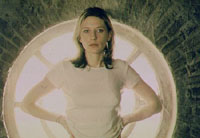
Heaven lived up to its name for me today. The follow up to the follow up
of Run, Lola, Run, Tykwer this time directs the final script by the two
Krzysztof's, Piesiewicz and Kieslowski, the fine collaborators who made
Decalogue and the astonishingly good Trois Couleurs
series.
I was suspicious of this film - for no particular good reason, I
felt that Cate Blanchett and Giovanni Ribisi would be "too Hollywood." It's a
stupid reaction, as the two are hardly A-list stars (by no means an insult),
but their recognition factor turns the brain from "indie fun" to "recognizable
stars", and I've seen some bad movies when stars rough it in the indie
mould.
What can I say - my gut was wrong. Sometimes actors are
celebrated because they're good. I hazard to say that in this film, the
two are in fact excellent.
Meanwhile, Tykwer shows that he can take a
lovely little story and tell it with astonishing visual creativity. There are
some really wonderful visual compositions in the film, one standout reminding
one of the famous UN side-of-a-building shot in North by Northwest. The
camera movement is always fluid and never gratuitous, with exceptionally
dexterous crane shots mixing it up with simple, delicate dolly moves. Tykwer
once again displays impeccable craft.
The story itself holds a sense of
stark reality and raw emotions mixed with a sense of flight and fantasy. This
strange mix strongly reminds me of a film like Bleu, but equally of
Tykwer's own Princess and the Warrior.
Tykwer's now officially
on my list of director's who'se films I refuse to miss - for me, the third
strike's a charm, and I'd like to dig out his pre-Lola films to see what
he has to offer.
Grade: A
 |
Ararat
Directed by Atom
Egoyan
Sad, but true. This, perhaps Egoyan's most personal film, the
one that the star (or his publicity team) called his Schindler's List,
is a dud.
It'd make for an excellent pitch - the untold story of the
Armenian genocide told through unconventional means, set in present day Toronto
to reflect the affect that the history has on the present, avoiding
cliché by utilizing a film-within-a-film technique to outline historical
fact.
Great idea. Execution poor enough to compare it to a
Lifetime/VisionTV Movie of the Week. I expect more from the festival's darling,
and have never been more disapointed with one of his film (loving almost all of
them, going back to Next of Kin).
It's hard to put my finger on
what's so unsatisfying - most of the performances were OK, it was shot pretty
well, seemed like every other Egoyan film at first look. I think it's that in a
film where every detail is meant to be historically accurate (there's even a
card at the end of the film indicating that "holocaust experts and historians"
have verified the content of the film) there's a heck of a lot of times I was
not believing in what I saw on screen. It was not, of course, the history that
concerned me, but the forced, often times comically bad transitions required to
squish all he wanted to say into a 90 minute frame.
For example, there's
a complicated story involving an Art Historian, her son, and her step-daughter
(who happens to be sleeping with the son.) The confrontation between mother and
daughter/son's lover is so forced and trite that after the third time it
happens you want to yell at the screen for at least one of them to shut up and
either get a restraining order against the girl, commit the mother to an
institution, or remove the son from the picture all together. This, along with
a all-to-convenient story involving a customs agent, seems to be clever for
clever's sake, a Device with a capital-D meant to provide context for the
historical fact.
The tough, and really sad part about all this is that
the history simply isn't known to a common audience, so by having to tease out
the complicated narrative in such a way, Egoyan is in fact clouding the very
centre of the film. For me, the only thing I really know about this history is
that there are academics and historians that challenge the very notion that
there was a genocide, a fact touched on in the film and, I think, dismissed in
a pretty respectable way (at least the issue was dealt with). I would love to
see an impassioned documentary by Egoyan, an honest story about the past, with
him visiting the area, his voice on the handicam as he's bribing guards up to
Mount Ararat.
By forcing the story into a narrative framework, he
dilutes the power of his message - namely, that the world does no forget the
million who died. In the end, Egoyan's own powerful voice is drowned out in the
wake of his tale, and the power and relevance of his message is lost. This film
will be forgotten, sadly, and its message will not be heard by those who need
to hear it most.
Grade: C
Sur le bout des
doigts
Directed by Yves Angelo
Serendipitous
scheduling - that strange fate when a film that you didn't particularly want to
see based on the description in the book fits nicely between two you want to
see. Do you go eat and rest for a couple hours, or plow through and see
something that you'd never expect to see at any other point again?
This
time, I went to the flick. And, somewhat surprisingly for me, I enjoyed the
film.
The description of the film in the guide pointed to Bergman, often
a red flag to avoid the flick. In this case, it's a very accurate relation, and
a positive one at that. It's a highly psychological film, with plot giving way
to intense character examination. It reminds me very much of
Persona.
The film begins with the pleadings of a mother talking
to an incubator, making promises to her prematurely born daughter. She's
putting her soul into the fragile life traped in an acrylic cage, fighting for
its life offscreen. We are then introduced to the daughter grown into her
teens, raised in a box of a different kind, the walls of her mothers house.
Like the incubator, it's a loving box, nurturing and comfortable while being
restrictive. The daughter and mother share a gift for the piano, and much of
the film plays out with close shots of fingers playing complicated
concert-piano scores.
The fluid dynamic between the temporal setting of
the film, combined with the shifts between the mother/daughter relationship
(with the daughter's skills surpassing the mother's making for conflict) makes
for an interesting film. A gamble that payed off well indeed.
Grade:
B+








